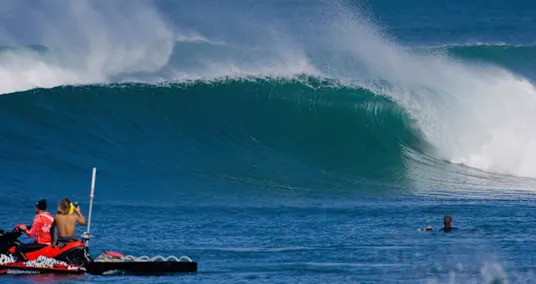
This iconic right-hand, point-break is nestled in an ideal location on the Surf Coast of Victoria to harness both wind and swell. Its reliable conditions have established it as a world-class competition venue and a treasured home-break for countless surfers over the decades. In this article, I'm going to dive into the key elements that have made this wave so legendary.
Swell Source
The Southern Ocean stretching between Australia and Antarctica, and extending west into the South Indian Ocean, is one of the most active zones on the planet for storm activity. These storms are strongest and most frequent from April through September (the Southern Hemisphere's winter months), but swell-producing systems can develop at any time of year.

Swell Window
Storms that develop a strong and well-aimed fetch between 224° SW and 196° SSW are ideal for Bells, as there are no obstructions for inbound swell. Due to the orientation of Bells (generally facing southeastward), incoming swell west of 224° will feel a degree of shadowing by Australia itself - the more west, the more it will be shadowed, and therefore less energy making it into Bells. Swells east of 196° will feel partial shadowing by islands off the coast of Tasmania, then blocked by Tasmania east of 175°.

Bathymetry
An offshore underwater ridge stretching to the south will help to refract a greater share of the inbound swell toward the gradually rising rock reef at Bells. While it isn’t a classic point break, the waves often act like one—concentrating their energy at the top of the reef where it peaks. From there, the local bathymetry takes over, guiding the swell as it refracts from the deeper bay into the shallower reef along the point, producing the long, clean right-hand lines Bells is known for.

Long-period swell (over 15-16 seconds) interacts more effectively with the bathymetry, allowing the energy to focus and wrap into the break with greater precision.
The ideal swell direction for shape falls between 215° and 196°. Swells arriving from farther west tend to produce flatter faces and break wider on the outside reef, missing the famed end bowl section. These conditions are often better suited to Winkipop, Bells’ neighboring break to the east.
When the swell comes from a more southerly angle, it strikes the top of Little Rincon—the section of reef directly below the Bells cliff—more directly. This produces a steeper, more hollow wave throughout, though it can also be faster and more sectiony down the line.

Wind
Given the general southeasterly exposure of the beach, straight offshore is from the northwesterly direction. Light to moderate offshore flow from the west through northwest is ideal, or calm to light/variable wind for glassy surface conditions.
High-pressure positioned to the north over New South Wales or Queensland, with its counterclockwise circulation, will deliver west to northwest winds to Bells.
While offshore for some other locations in the area, a N to NE wind is a “devil wind” at Bells and Winkipop, especially when moderate to strong. A light wind from the straight N is OK.

Best Specs
Swell Direction: SW to SSW (215-196°)
Swell Period: 15-16 seconds or longer
Surf Size: Chest-high to triple overhead
Wind: West to northwest
Tide: Low for the Bells Bowl and high for Rincon
This story was originally published by Surfer on Apr 2, 2026, where it first appeared in the News section. Add Surfer as a Preferred Source by clicking here.
LATEST POSTS
- 1
 Hezbollah field commander killed in IDF strikes in Beirut
- 2Eli Lilly weight-loss drug appears to suppress binge-eating signal, small study finds
- 3Figure out How to Advance Space in Your Pre-assembled Home for Upgraded Usefulness
- 4Heavy rain, floods kill at least 45 people in Afghanistan, Pakistan
- 5Are IDF reservists properly armed during post-war operations?





- Should you get an RSV vaccine this fall? What to know and where to get a shot
- Fuel Price Spike Drives Surge in Used EV Sales in Europe
- Virtual Domains d: A Survey of \Inundation and Ongoing interaction Mechanics\ Computer game
- Struggling to keep your New Year's resolutions? Here's how to keep yourself on track
- Nature carves colossal snowman in Siberia | Space photo of the day for Jan. 2, 2026
- Eli Lilly to build $6 billion Alabama plant as part of US manufacturing push
- Spanish police and soldiers track boars, reinforce farm security amid swine fever outbreak
- France's Senate backs ban on social media platforms for under-15s
- Burkina Faso must 'forget' about democracy, military leader says