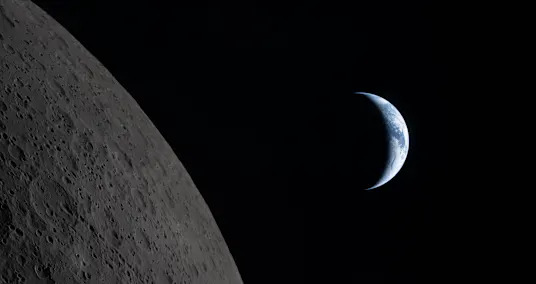
NASA has released the first images taken by the Artemis II crew during their historic trip around the far side of the moon.
The four astronauts — NASA commander Reid Wiseman, pilot Victor Glover, mission specialist Christina Koch and Canadian Space Agency mission specialist Jeremy Hansen — spent Monday’s seven-hour lunar flyby taking photos and making observations from the Orion spacecraft, which they named Integrity.
Among the stunning new images uploaded by NASA on Tuesday was a photo of “Earthset,” which was captured through the Orion capsule’s window at 6:41 p.m. ET, according to NASA.
"A muted blue Earth with bright white clouds sets behind the cratered lunar surface," the photo caption reads. "The dark portion of Earth is experiencing nighttime. On Earth’s day side, swirling clouds are visible over the Australia and Oceania region.”
Visible in the foreground is the moon, with the Ohm crater’s “terraced edges and a flat floor interrupted by central peaks,” per NASA’s description.

The crew also captured “Earthrise,” recreating the iconic photo taken during the Apollo 8 mission in 1968.

Also included in the new batch of images is a view of the solar eclipse that the crew experienced near the end of the flyby.

The astronauts donned eclipse viewers to protect their eyes during the nearly hour-long celestial event. But they still struggled to put into words what they were witnessing.

“Humans probably have not evolved to see what we're seeing," Glover told mission control. "It is truly hard to describe.”

Other photos captured close-up views of the lunar surface, including little-seen craters and basins from the vantage point of the crew, which at one point came within about 4,000 miles of the moon.
During Monday’s flyby, the Artemis II set a new record for the farthest distance from Earth traveled by humans — 252,756 miles, surpassing the previous mark set by Apollo 13 in 1970.


LATEST POSTS
- 1
 5 Signs Now is the ideal time to Update Your Android Telephone: When to Take the Action
 - 2Survey: Canteen Cups With Great Warm Protection Impact
- 3Raw oysters linked to ongoing salmonella outbreak infecting 64 across 22 states: CDC
- 4'Stranger Things' Season 5: What's going on with Will Byers? That shocking Volume 1 plot twist, explained.
- 5Turning into a Distributed Writer: My Composing Process



- Your guide to how to safely thaw and cook your Thanksgiving turkey this year, according to experts
- Slovakia rejects EU call to scrap higher fuel prices for foreign cars
- Charlotte faith leaders hold interfaith forum on Black and Palestinian solidarity
- Strengthening through Wellness: Individual Preparation Achievement
- IDF uncovers 7 km.-long Gaza terror tunnel where Hamas held Hadar Goldin
- Creative Tech Contraptions That Will Work on Your Life
- What's the new 'Knives Out' mystery about? Everything to know about 'Wake Up Dead Man,' including who's in the cast and what the reviews say.
- Saturn shines with the waxing moon at sunset on Nov. 29
- Father and son spending Christmas together after health scares